This page contains all the tank events from 1 April 2007 to 30 June 2007.
Forward to later fish pages, back to earlier fish pages, to
main fish page.
We've noticed what might turn out to be some baby Toadstool Corals. They have sprouted along the line where the Toadstool Coral has moved, leaving behind what we thought was just dead stalk.

Here are pictures of each one through the Mesoscope (from left to right).
 |
 |
 |
Of course they could equally be Pulse Coral, but why would they be grouped along the line where the Toadstool Coral went if that were the case?
For a while we've had some interesting algal colours developing in the tank. There are the standard purples and reds, but then there's some orange in amongst the red, some bright green and even some bold blue.
 |
 |
 |
We think these are all good algae, but there is also some dark brown stuff developing in a caking sort of way, stuff which our vegetarian fish don't seem to want to nibble. We scrape this off every so often.

And now a pair of Clown Fish (not four - they are up at the surface, hence a reflection). There is evidence of haranguing from the Pyjama Wrasse, but we hope the Clown Fish have strength in numbers.
 |
 |
Restocking, and in honour of Hannibella, we bought a pair of Ocellaris Clown Fish today, no more than 2 cm long. Unfortunately one of them was lethargic on entering the tank and didn't last more than a few hours. We'll go back to the shop tomorrow. An immature pair will change sex to form a mating couple and should look after each other against the bigger-boys in the tank.

Tried to get some pictures of the copepods in the sump tank through the Mesoscope last night. They didn't come out very well I'm afraid, as the subject was moving and the positioning prevented me getting a tripod to the camera. Anyway, here's the best one of them. The creature is sitting on a leaf of the red algae, which itself is no more than a few millimetres across.

Realised today that we haven't seen the Rust Angelfish for a while. Could it have died as well? I wonder if my clumsy addition of too much Kalkwasser on 11th April stressed the inhabitants and caused these deaths? It couldn't be responsible for the Finger Leather Coral problem as that occurred before 11th April. Hummm.
Sadly, Hannibella is no more. She was the first ever fish in our first ever tank back in February 2002 and has survived all our very variable attempts at marine fish keeping. She's murdered many fish along the way of course, but since her isolation that's not been a problem and we've grown to love her again. The picture below shows the surface damage to her skin from what we believe was Lymphocystis. Bye bye Hannibella.

The Finger Leather Coral has got really bad now, more shrivelled and pulling away from its connection to the rocks entirely.

It seems we may have spoken too soon about Hannibella: the disease has spread all across one side of her body, affecting one fin and making it difficult for her to guide herself through the water. Her breathing is laboured, so we've tried a 2 minute dip in fresh water to see if it helps. We don't hold out much hope though.
Finally, the Mushroom Coral has suffered from the urchin knocking away from its various rocks so many times now that it has crumbled to virtually nothing. The urchin seems almost magnetically attracted to it. There is a small possibility one of the fragments may survive, but we somehow doubt it.
On a positive note, none of these problems have affected anything else in the tank.
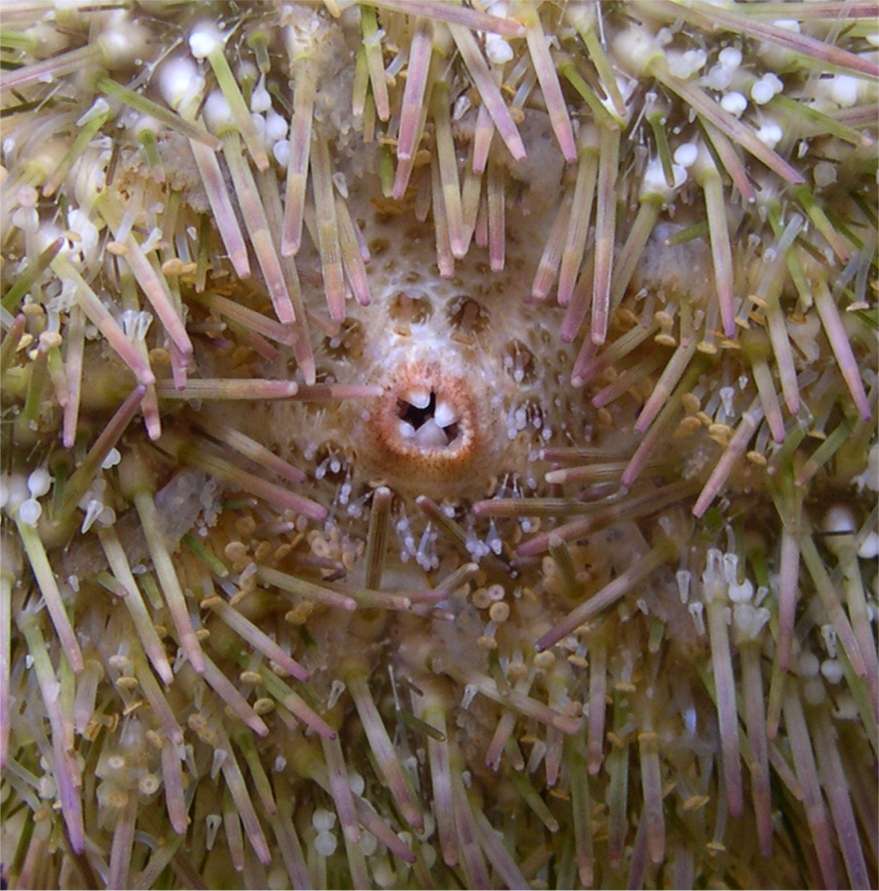
The urchin was attached to the side of the tank tonight on one of the areas where we've allowed coralline algae to grow. Thought it worth taking a picture of the creature's chewing action using those scary teeth; it has an impressively large mouth.
 |
 |
 |
This evening the large cauliflower-shaped scab fell off Hannibella. Looks like even a virus doesn't stand a chance in a fight with her.

In adding the top-up system, we had to order a few bits from RO Man and happened to notice a rather neat (and cheap) in-line TDS (Total Dissolved Solids) meter. We've fitted one of these now and it shows that our RO system is working well.

We noticed today that Hannibella is suffering from quite a severe skin problem. The skin appears to be bubbling-up in a blister-like way. Thanks to Dave K at Reef Aquarium Guide for advising us that it is Lymphocystis, also know as Cauliflower Disease. This is a viral infection, generally non-fatal: rather like warts for fish. There is no known cure and it is spread through contact, so Hannibella's isolation in the sump tank means it won't spread. We have crossed some more fingers.
 |
 |
 |
In the last week our Finger Leather Coral has drooped, looking quite ill. There seem to be some white streaks developing in areas of its trunk. Doesn't seem to be much we can do, so we're just keeping our fingers crossed.
 |
 |
We've got sick of the water level in the sump dropping below the level of our expensive tank monitoring system and so have now fitted a Deltec float-switch system. We chose the low-voltage solenoid option fed directly from the RO unit. Just in case the float gets fouled or the solenoid jammed the unit is powered via a standard mains timer so that it is only active for twenty minutes each day (so no more than 3 litres of water can be added, given my RO unit's flow rate).
While picking this up from Aquatic Fanatics we spotted another Flame Scallop, this time an Indonesian variety which is the sort that shows the neon lip. It's really amazing to see it in action. The neon is a static stripe on the edge of the lip covered by a flap which the scallop ripples back and forth.
 |
 |
 |
 |
So that you can see quite how wild this thing is, the video below shows the flashing neon from two angles, then a close-up with the Mesoscope and finally a version at half speed: can you convince yourself there's a moving flap in there?

To make it easier, here's a sequence of five frames around the flash itself. There seem to be two separate flashes: maybe the ripple out-bound and return?
 |
 |
 |
 |
 |
To prove that this Flame Scallop is as lively as our previous example, here it is moving around.

Finally, Alice decided to do a count of the number of tiny starfish in the tank. She stopped counting at 100. We don't remember seeing quite this many tiny starfish in other tanks - is it normal?